kusa no to mo / sumikawaru yo zo / hina no ie (Even a thatched hut / May change with a new owner / Into a doll’s house)
from a haiku poem in Oku no Hosomichi (奥の細道) by Matsuo Bashō (松尾 芭蕉) (1644 – 1694)
I`ve been following the discussion on
Clarissa`s blog for the past few days about why twenty five percent of all Americans
and over 30 % in some states are obese according to international statistics.This shouldn`t be surprising for a country
that gave the world Spam (precooked meat product), Reddi Whip (vegetable oil masquerading as whipped cream)
and Velveeta cheese slices (Pasteurized processed cheese product with 13 ingredients). According to some newspapers such as the Guardian
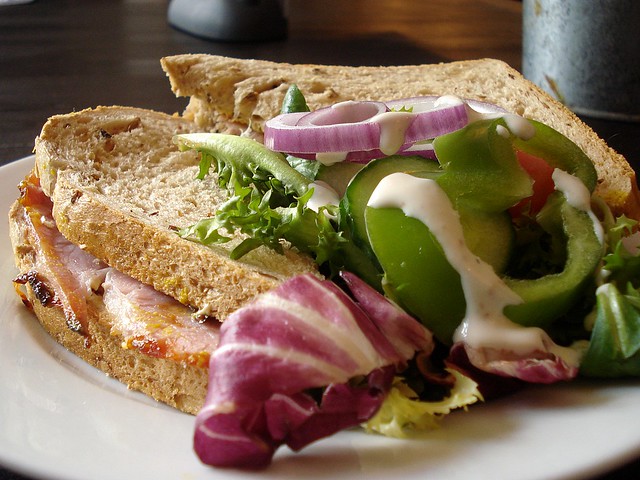
newspaper in England which posted the photo at the top in an article on obesity if they
stopped stuffing their faces with freedom fries and read books like “French
women don’t get Fat” by Mireille Guiliano, a French citizen who moved to the
States in the wealthy Boston suburb of Weston as a student for a year and put on 15 lbs before she returned home
and regained her gamine form, things would change.
Unfortunately Yankee ingenuity is still at work and on November 14th, 2011
McDonald reintroduced the McRib to their chain of fast food restaurants across
America with the ad displayed below. If you read the list of ingredients on
their website, it sounds pretty innocuous - McRib Pork Patty, McRib Bun, McRib
Sauce, Pickle Slices, Slivered Onions but the item contains 70 ingredients
including 980 mg of Sodium (more than you need in a day!), 29 gm of fat and
other industrial chemicals such as azodicarbonamide, ammonium sulfate and
polysorbate 80 according to an article in Time Magazine which
also stated:
Azodicarbonamide,
a flour-bleaching agent that is most commonly used in the manufacture of foamed
plastics like in gym mats and the soles of shoes, is found in the McRib bun.
The compound is banned in Europe and Australia as a food additive. (England's
Health and Safety Executive classified it as a "respiratory
sensitizer" that potentially contributes to asthma through occupational exposure.)
And the meat in the McRib according to another
post
is:
Pig
innards and plenty of salt. Typically, "restructured meat product"
includes pig bits like tripe, heart, and scalded stomach, says Whet Moser at Chicago Magazine, citing a 1995 article by Robert Mandigo,
a professor at the University of Nebraska. These parts are cooked and blended
with salt and water to extract salt-soluble proteins, which act as”glue"
that helps bind the reshaped meat together.
<
Mireille Guiliano had a similar experience to Clarissa and
wrote in the introduction to her book, "French Women Don`t Get Fat", the
following:
My father brought my brother with him to Le Havre to collect
me. I was traveling on the SS Rotterdam. … Since he had not seen me for a whole
year, I expected my father, who always wore his heart on his face, would embarrass
me, bounding up the gangway for the first hug and kiss. But when I spied the
diminutive French man in his familiar beret – yes, a beret – he looked stunned.
As I approached, now a little hesitantly, he just stared at me, and as we came
near, after a few seconds that seemed endless, there in front of my brother and
my American shipmate, all he could manage to say to his cherished little girl come home
was, ``Tu ressembles a` un sac de potates.``
So the puzzle is how different the food in Canada with the
green area representing the low end of the obesity spectrum is from the food in
the States with the high end of the spectrum in red as represented in the map
above. Certainly the McRib is quite different from the food at the Saint
Lawrence Market about which I posted lately on my blog. Last night, Michael Moore
said on a panel discussion about the Occupy movement at a school in New York that he ate his first tomato
last year and he is in his forties.
Quebec certainly has the food thing figured out and try finding an overweight person at Place Alexis-Nihon or Carrefour Angrignon in Montréal.
This is in spite of the Québécois predilection for Poutine and Queues de Castor
which aren’t the most thinning items but the foods are certainly less loaded up
with industrial strength additives and the food laws are definitely more stringent.
Chip butty licenced from flickr
This is a truncated version of a long thread on Clarisse’s
post which tended to have comments that diverged from the initial discussion points. It's interesting that England, the source of the photo at the top of the post, doesn't always have the best food and anyone who has had a chip butty or bangers with mash knows what I'm taking about. The British Rail sandwich has been a butt of jokes for years and an article in the Daily Telegraph spoke about it:
The inner secrets of one of the nation's most reviled culinary creations - the infamous British Rail sandwich - were exposed yesterday.
A 30-year-old document unearthed from a collection of discarded BR papers shows how staff were expected to be meticulous about making the finished product suitably unappetising.
First, a trick: stack the filling on the middle of the lower slice of bread, so that when cut in two it would appear fulsome and vaguely attractive.
Second, a tip. When dealing with luncheon meat or sardines, the filling should amount to two-thirds of an ounce. In the case of cheese the quantity was to be increased to three quarters of an ounce, while gherkins were limited - probably quite sensibly - to a quarter of an ounce.
British Rail Sandwich licenced from flickr
ADDENDUM: November 17, 2011
In spite of Obama Administration’s efforts in general and
Michelle Obama efforts in particular to provide more health school lunches to
poor children by updating and raising nutritional guidelines for federally
funded programs, today Congress passed a bill bowing to the fast food lobby which
acknowledged that pizza would be considered a vegetable for nutritional guidelines
with respect to school lunch food as well as no reduction in salt levels. We
can look forward to another generation of unhealthy Americans with widespread
diabetes and heart disease. The particulars as outlined in an article in the
Daily Mail were:
Block the Agriculture
Department from limiting starchy vegetables, including corn and peas, to two
servings a week. The rule was intended to cut down on French fries, which some
schools serve daily.
Allow USDA to count two
tablespoons of tomato paste as a vegetable, as it does now. The department had
attempted to require that only a half-cup of tomato paste could be considered a
vegetable — too much to put on a pizza. Federally subsidized lunches must have
a certain number of vegetables to be served.
Require further study on long-term sodium
reduction requirements set forth by the USDA guidelines.
Require USDA to define 'whole
grains' before they regulate them. The rules would require schools to use more
whole grains. Food companies who have fought the USDA standards say they were
too strict and neglected the nutrients that potatoes, other starchy vegetables
and tomato paste do offer.
'This agreement ensures that nutrient-rich vegetables such as potatoes, corn and peas will remain part of a
balanced, healthy diet in federally funded school meals and recognizes the
significant amounts of potassium, fiber and vitamins A and C provided by tomato
paste, ensuring that students may continue to enjoy healthy meals such as pizza
and pasta,' said Kraig Naasz, president of the American Frozen Food Institute.
The following video from last night shows Jamie Oliver's reaction to the events which I just described.
Saint Lawrence Market is Toronto`s largest farmer’s
market and the oldest in the city. The land was originally designated as a
market in 1803 and the city’s original City Hall (1845 – 1899) is actually part
of the current building at the corner of Jarvis and Front streets in the heart
of historic Old Town and south east of the core of downtown. Today there are
more than 120 food retailers who sell every kind of meat, fish and bakery goods
including organic from most legal animals and fish.
I like to come here on Saturday and purchase unique, fresh produce that I can`t buy anywhere else in Toronto including my favorite supermarket about which I have already posted. The only problem is that there is almost too much choice.
Below is a short
video on the market by Bruce Bell, a Toronto historian.
Fresh rare heritage and heirloom carrots.
Going in the front door in the picture at the top of the post.
Main food hall looking south from the north end.
Buskers in the market
Canadian back bacon
Cheeses from around the world
Freshly made paste in any colour
Oysters on the shell
Domenic’s
Fish Market sells a wide selection of seafood. Live crabs and lobsters are
available as well as shellfish, shrimp, tuna, whitefish, halibut, trout, Arctic
char, cod and salmon. They specialise in vodka smoked salmon.
The picture above is a 360 degree, tilt, pan and zoom photo
of the PATH system. Be sure to see it in full screen and move the image around
to get a great impression of this part of the underground complex.
The underground path system in Toronto started in 1917 when
five tunnels were dug in the center of the city and then Union Station, the
main railway station, was opened in 1927 and connected to the Royal York Hotel.Finally the current complex was started in
the 1970s leading to a length of approximately 30 km or 17 miles.
Toronto PATH system from flickr under licence
The present system connects Toronto City Hall, grocery
stores, three schools, five condos, five subway stations, six hotels, six
cultural sites, over fifty office towers as well as 1200 retail stores.
One of the criticisms of the complex is its maze like design
due to local commercial additions without an overall definition of expansion
and the difficult signage interpretation. Colour codes for directions of the
compass are not often useful and visitors often feel as if they‘re trapped in a
labyrinth without an exit.
The map below is a representation of the master plan for the
expansion of the PATH system from its current 30 km of underground walkways to
almost 60 km. in the future making it by far the largest complex of its type in
the world.
Master Plan
The future goal is not just to link more buildings and
public facilities, but also to connect with nearby public spaces and parks,
such as Berczy Park and the Queen's Quay/Waterfront area. Hospitals will also
be connected and one will able to live, work and play in downtown Toronto
during inclement weather without being exposed to the elements which is great
considering the large variation in temperature of Toronto during the year from
freezing cold to very hot.
The picture below is a 360 degree, tilt, pan and zoom photo
of the PATH system. Be sure to see it in full screen and move the image around
to get a great impression of this part of the underground complex.
I’m trying some new things in this post.
The top is a 360 degree panoramic picture where you can pan, tilt and zoom
around Saint James Park from the position indicated below in the map of the park
as “360 location”.The map
also has the locations of various tents in the encampment in red and this
will also help you to orient some of the pictures. The blue arrow shows the
march path of the protestors.
Map of encampment in Saint James Park
The park is partly the private property of the
Diocese of Toronto and so long as the Cathedral supports the Occupy Toronto encampment;
the police can’t evict the campers from the church portion of the park. On Sunday, October 23 the Cathedral made an
official statement:
Sunday, October 23, 2011
For decades St. James
Cathedral and the City of Toronto have worked together to provide the public
space of St. James Park. It is a beautiful and appreciated urban oasis that
blends seamlessly with the magnificence of the neo-gothic Cathedral which we
cherish as evidence of God’s presence in the city.One week ago, Occupy Toronto
protesters chose the Park as their meeting place. Their movement is part of a
worldwide response to increasing economic disparity. Protests are taking place
all over the globe. The Cathedral did not invite the protesters into the Park.
The Cathedral is not involved in the protest. We have, however, treated the
protesters in the way that our faith and sense of humanity directs: with respect
and dignity. For over 200 years, St. James Cathedral has been a place where
divergent opinions have come to be expressed in a safe and respectful
environment. We have asked that the protesters respect the members of the
community who live and work in the area. The overwhelming response from the
members of the community to the Cathedral’s position on this issue has been
positive. They share, as do we, the protesters’ message of justice and
equality. We fully appreciate the frustration of some of the neighbors to the
disruption. The anger at the Church, however, is misplaced. We have no power to
evict the protesters. We cannot speak for the City but even if we did have that
power, we would be very reluctant to invoke it. We believe that we are blessed
to live in a society where peaceful conversation can take place publicly and
where citizens are free to voice their concerns without fear of violence or
reprisals.
The Very
Reverend Douglas A. Stoute
Dean of Toronto and Rector
of St. James Cathedral
North of First Aid Station
Since my last post, the camp has set up an
onsite school and library.Classes and
workshops will be taught for free at the camp school by experts from the local educational
institutions. I noticed that one of the lectures written on the white board was on Zizek and his take on the movement. Danara Dourdoussoua is the librarian for the camp library and she has a degree from
the University of Toronto in Political Science, Economics and International
Relations.
“Everything is donated, we don’t ask for
information and we don’t have library cards. We do know that some of the books
will not be returned. We just want to get people reading — we even invited the
police to come and take a look. People can share any skills they have, be they
academics with alternatives to capitalism, or practical skills, showing others
how to set up a tent. The point of it is knowledge.”
School Classroom
There were some people from New York State who arrived to show
their support in the march to Toronto city hall on Saturday. Buffalo has a small Occupy group so we got the folks that felt they would get more attention demonstrating here which is interesting because their city is in pretty bad economic state with one of the highest foreclosure rates in their state compared to Toronto where most houses sell in a few days and housing prices have increased by ten percent this year.
Visitors from Buffalo
"We
the First Nations Defenders of the land wish to convey the message that we have
come to aid in the peaceful Occupation of St. James Park. We have ceremoniously
lit a sacred fire and we will protect this fire. We will protect this fire for
the Health and Safety of all the Occupy Toronto protestors and all peaceful
assemblers around the globe. We firmly state we will not allow this sacred fire
to be extinguished by no one but those who understand the rituals and respect
such a ceremony requires. Occupy Toronto has stated their belief that the
Indigenous Peoples within St. James Encampment are a fundamental pillar within
this community, just as we have prospered from all people working together for
this community. Occupy Toronto wishes to reaffirm our solidarity with the
Indigenous People who have developed and supported our view of honouring Mother
Earth. She continues to sustain our ability and livelihood to peaceably
assemble. It is our hope that this movement helps the Global Community to
recognize the need for all people to live in a just, fair, and respectful
society."(Occupy Toronto website)
Jason Fleury of the Mohawk Warrior Society and John Fox
of the Ontario branch of the American Indian Movement were present. A group of
native drummerswere very active in their part of the encampment and said that the local land was still their property because they didn`t recognise the various treaties which effectively stole their land for insignificant amounts of money. My Ex who comes from a United Empire Loyalist family and they also feel that their land was illegally confiscated from their ancestors by the Continental Congress during the American Revolution so nobody ever forgets past issues.
Native American section
This photo of campers chatting was actually taken on top
of a former cholera pit which was used for mass burials during the cholera epidemic
of 1832. Some of the city workers say that when they rake the lawn during the spring, sometimes human bones will be on the surface.
Social moment
The library currently contains mostly economic and political science texts but is starting to have a growing fiction section and has been moved to the new library yurt as of this week so the experience is a lot more pleasant.
Original Library exterior
“I have always
imagined that Paradise will be a kind of library.”
― Jorge Luis
Borges
Original Library interior
I was down at the local encampment on Saturday and watched a
camera crew for a major news organization hunting around the very neat and tidy
camp site looking for a piece of garbage to film which emblematic of the fact
that most of the mass media commentators have their narratives worked out
before they even arrive on the scene. I watch and observe. Collect data and
then analysis while paying close attention to inherent assumptions. Even then I
hesitate to draw conclusions because I sense that this Occupy movement is in
the process of becoming. Most observers treat the event as a Rorschach
pattern onto which they project their own thoughts and hopes or fears.
North of Library on path
<><><><><><><><><><><><><><><><><>
Occupy Toronto also got used in Gov. Rick Perry’s Republican primary race
when he referenced a fabricated quote from the Globe and Mail newspaper. This
was picked up and posted on the American Spectator as well as the “I am the 53%”
conservative Facebook group so be careful what you read about the movement in
your northern neighbor especially when it comes from conservatives.
At an appearance in New Hampshire last week, Mr. Perry, struggling to
regain momentum in the race, made reference to the quote, which he said was
sent to him by his son.
“This was in Toronto,” he told the crowd before paraphrasing the fabricated
quote in an Oct. 21 Globe and Mail essay by freelancer Mark Schatzker. The
piece was clearly labelled satire.
Mr. Perry summarized the quote as: “I guess greed just makes you work hard.
``
The satirical quote by Mark Schatzkerin, Glove and Mail humour columnist,
in its entirety is as follows:
“It’s weird protesting on Bay Street. You get there at 9 a.m. and
the rich bankers who you want to hurl insults at and change their worldview
have been at work for two hours already. And then when it's time to go, they're
still there. I guess that's why they call them the one per cent. I mean, who
wants to work those kinds of hours? That's the power of greed.” – Jeremy, 38
The police were conspicuous by their absence around
the campsite due to the fallout from their behaviour during the G20 protests
when the public was outraged by the overreaction on the behalf of the police who were in
riot gear to peaceful protestors including a disabled
senior who was nowhere near the conference site. A good PR move.
Over time I notice the interplay between the participants,
the spatial locations of their tents within the park, the physical attributes
and material possessions of the campsites and the temporal modifications of the
fore mentioned elements. It`s interesting that the main paved path has become
the main street of the community where most of the communal structure such as
the school, logistics, sign production, information booth and library are
located. On the west side of the path, the pup tent proletariat group are
located while on the east side of the path lie the middle class mega tent
ensemble. The Bolsheviks and the Socialists have their red flags with pictures
of Karl Marx in Commie corners, a suburb in the south east corner of the park
most distant from the Anglican St. James Cathedral that looms over most of the
park in all its Gothic glory.
The indigenous people like the Mohawk Warriors Society are
the folks that have this encampment lifestyle figured out the most since they
pitched their tents on the high ground nearest the food tent while the urban
dweller rubes settled down in the low areas which were the first to be flooded
by the rain. They are also preparing for winter because they’re in for the long haul and so being the first peoples so will they
be the last in this park.
Things are getting more organized
Air Canada has donated six rolls of thermal insulation
for the tents and the camp has a two person building inspection team that
travels around the park to ascertain whether the tents are ready for winter.
Workers of the World Unite!
The situation at St. Paul’s Cathedral in London, England
with respect to the Occupy London encampment seems to be changing by the hour. The
approximately two hundred tents are sited on property which is jointly owned by
the Cathedral and the Corporation of the City of London not
unlike the St. James Park in Toronto which is partly owned by the Cathedral and
the City of Toronto. According to a recent article in the Guardian newspaper,
the Anglican corporation has decided to “reconnect financial with the ethical.”
Activists campaigning
against financial inequality and banking excesses look set to remain
camped outside St Paul's cathedral well into next year after both the church
and the Corporation of London, which jointly own
the land the protesters have occupied for more than two weeks, said they were
halting moves to evict them.
While the corporation said it had merely "pressed the pause button" on its
legal bid, St Paul's delighted the Occupy London movement
with a statement that explicitly lined up the might of one of the Anglican
congregation's most celebrated institutions behind their call for greater
social justice.
The Anglican Church in Canada while closely connected with
the elites like its mother church in England has never been an established
church and, of course, the class structure in Canada has never been as rigid as
England. The Corporation of the City of London is the most undemocratic
institution in the western world and from another article in the Guardian:
What is this thing? Ostensibly it's the equivalent of a local council,
responsible for a small area of London known as the Square Mile. But, as its
website boasts, "among local authorities the City of London is
unique". You bet it is. There are 25 electoral wards in the Square Mile.
In four of them, the 9,000 people who live within its boundaries are permitted
to vote. In the remaining 21, the votes are controlled by corporations, mostly
banks and other financial companies. The bigger the business, the bigger the
vote: a company with 10 workers gets two votes, the biggest employers, 79. It's
not the workers who decide how the votes are cast, but the bosses, who
"appoint" the voters. Plutocracy, pure and simple.
Exercise area. Too crowded to jog.
The solution to the cold winter is to keep fit and stay moving if that is possible which means that some of the folks with the smaller tents will have problems later so the solution is exercise and the procurement of larger warm structures to place in the park. Some people such as Clarissa on her blog feel that winter might bring an end to the encampment but the folks here are certainly in the winter preparation stage.
…However,
I’m not convinced that there is time. Winter is coming and it sounds like it
will be a pretty harsh one. In Montreal, we are promised the coldest winter in
20 years, and New York always gets whatever weather Montreal does. Then, the
holiday season will be upon us with its triple whammy of Thanksgiving,
Christmas and New Year’s. Who can judge the protesters if they decide not to
show up when it’s cold outside and there are things to celebrate?
Some unions have donated three Mongolian wooden yurts to
help the encampment deal with the winter. Nothing like living in a multicultural city to see an unexpected central Asian structure pop up in a local park. The largest took three days to put up
and is fifty feet in diameter. The video shows the yurt after it was built
while the picture was taken by me at the beginning of construction. One yurt
will be for the post office/ library while the other two will be for a medical
area and dining room respectively. This is a far cry from the Occupy Wall
Street winter preparations.
Traditional Yurt-Etiquette from a post on
Occupy Toronto blog
Traditionally, anyone stopping
outside of a Ger (Mongolian yurt)is invited in for a meal; a sheep is killed
for the feast (more practical on the lonely steppes of Mongolia than in this
overcrowded island). When entering the yurt it is considered impolite to step
on the threshold or to hold onto the ropes. The traditional greeting offered by
the visitor consists of four questions: are you well?, is your family well?,
are your cattle/sheep fat?, is the grass good? The answer to each of these
questions is yes, whatever the reality. After exchanging greetings the guest is
offered tea, followed by C and
then yoghurt. Visitors to a Kalmuk yurt are offered Arak, distilled spirit of Airag
(fermented horse milk), three glasses must be drunk in rapid succession.
Following these formalities men exchange snuff and the party can become more
relaxed. At the meal the guest carves and shares the meat.
There are a number of rules which
guests should follow. All weapons should be left outside, do not step on the
threshold, point your feet at or put rubbish on the fire. Do not sit with your
back to the altar, whistle, write in red pen, step over older people or point a
knife at anyone. One should take at least a little of any food or drink
offered. When offered Arak or vodka flick a small amount to the sky, the wind
and the earth before drinking.
c
The
library at Occupy Toronto will be having a grand opening on Saturday November
19, 2011. We encourage everyone to come and visit. We are also looking for
donations to expand the library. With the recent budget cuts from the city,
particularly the Toronto Public Libraries; which as Councilor Janet Davis (Ward
31) says is “the busiest libraries in the world ...innovative, highly efficient
and respected worldwide”; some of the occupants of Occupy Toronto have established
a free communal library. The library provides free, open and unrestricted
access to our collection of books, magazines, newspapers, and other materials
that have been donated, collected, gathered and discovered during the
occupation. We are inviting the Toronto community to visit our library as well
as donate literature. The Toronto Free library is located in St. James Park, south
of the info tent, north of the gazebo inside the orange yurt.
(from the Occupy Toronto website)
According to an article in the National Post
some of the books in the Occupy Toronto library are:
1) Animal Farm, by
George Orwell (three copies)
2) The Communist
Manifesto, Karl Marx
3) Plato’s Republic
4) The Trouble With
Billionaires, donated and signed by the author, Linda McQuaig, who wrote: “To
my heroes in Occupy Toronto. Down with billionaires! In solidarity, Linda.”
5) The Prince, Niccolò
Machiavelli
6) Manufacturing
Consent, Noam Chomsky
7) Alice in Wonderland,
Lewis Carroll
8) The Paper Bag
Princess, Robert Munch
9) Selected Works of
Berthold Brecht
Traditional yurts consist of a circular wooden frame carrying a felt cover.
The felt is made from the wool of the flocks of sheep that accompany the pastoralists.
The timber to make the external structure is not to be found on the treeless steppes,
and must be obtained by trade in the valleys below.
New Library Yurt from Jeff Hamilton
The frame consists of one or more lattice wall-sections, a door-frame, bent
roof poles and a crown. The Mongolian Ger has one or more columns to support
the crown and straight roof poles. The (self-supporting) wood frame is covered
with pieces of felt. Depending on availability, the felt is additionally
covered with canvas and/or sun-covers. The frame is held together with one or
more ropes or ribbons. The structure is kept under compression by the weight of
the covers, sometimes supplemented by a heavy weight hung from the center of
the roof. They vary with different sizes, and relative weight.
Library Yurt Crown from Jeff Hamilton
Traditional decoration within a yurt is primarily pattern based. These
patterns are generally not according to taste, but are derived from sacred
ornaments with certain symbolism. Symbols representing strength are among the
most common, including the khas (swastika) and four powerful beasts (lion,
tiyurt, garuda and dragon), as well as stylized representations of the five
elements (fire, water, earth, metal, and wood), considered to be the
fundamental, unchanging elements of the cosmos. Such patterns are commonly used
in the home with the belief that they will bring strength and offer protection. (Wikipedia)
Winter Quarters
ADDENTUM: November 18, 2011
Former
Toronto Mayor David Miller will join a distinguished panel of leading thinkers
in economics, law, and design for Occupied Economies: Designing Solutions to
Global Problems. This a free event that marks the first in a new series of
public panel discussions hosted by The Design Exchange (DX). The summit, taking
place November 18, 2011 at 4:45 p.m. at the DX will launch a dynamic
conversation including representation from Occupy Toronto aimed at identifying
global problems and crafting solutions through creative, cross-disciplinary
collaboration and redesign.
In addition to Mr. Miller, who is currently advising the World Bank on urban
sustainable development, the panel will be comprised of Dr. David Kennedy,
Harvard Law and past chair of the World Economic Forum’s Global Advisory
Council on Global Governance; Dr. David Schneiderman, University of Toronto Law
and author of Constitutionalizing Economic Globalization: Investment Rules and
Democracy's Promise; Dr. Sara Diamond, President, OCAD University; and Matt
Gurney, Deputy Editor, Comment Section, of the National Post. The Occupy
Toronto movement is sending an anonymous spokesperson; a current Bay Street
investment advisor, whose identity will remain concealed.
“Canada must engage, both locally and internationally,” says Tim Gilbert, DX
chair and president and principal of Gilbert’s LLP. In this globalized system,
Gilbert believes economic strife cannot be written off as a localized problem.
“The most critical issue every generation faces is whether citizens have the
means to support themselves at minimum, and ideally grow and create new
solutions so each new generation can be better than the last.” (Blog TO under Creative Commons licence)
Veiled is an exhibition at the Textile Museum of Canada by Andrew McPhail, Grace Ndiritu and Tazeen Qayyum which “examines the act of veiling the body
not only as a material and physical gesture, but also as an emotional and
personal process” and “the idea of a veil as a poetic device for the
investigation of public vs. private space, protection and intimacy.”
There will be a series of lectures around this topic such as
“Art of the Veil: Commoditization of a Cultural Practice?” where experts will
speak at the museum. I suppose that I will have to leave my assumptions at the
door and approach the point of view given by the speakers with an open mind
although I already have some strong feelings after seeing the exhibit. The
pictures will give you a truncated tour of the installation.